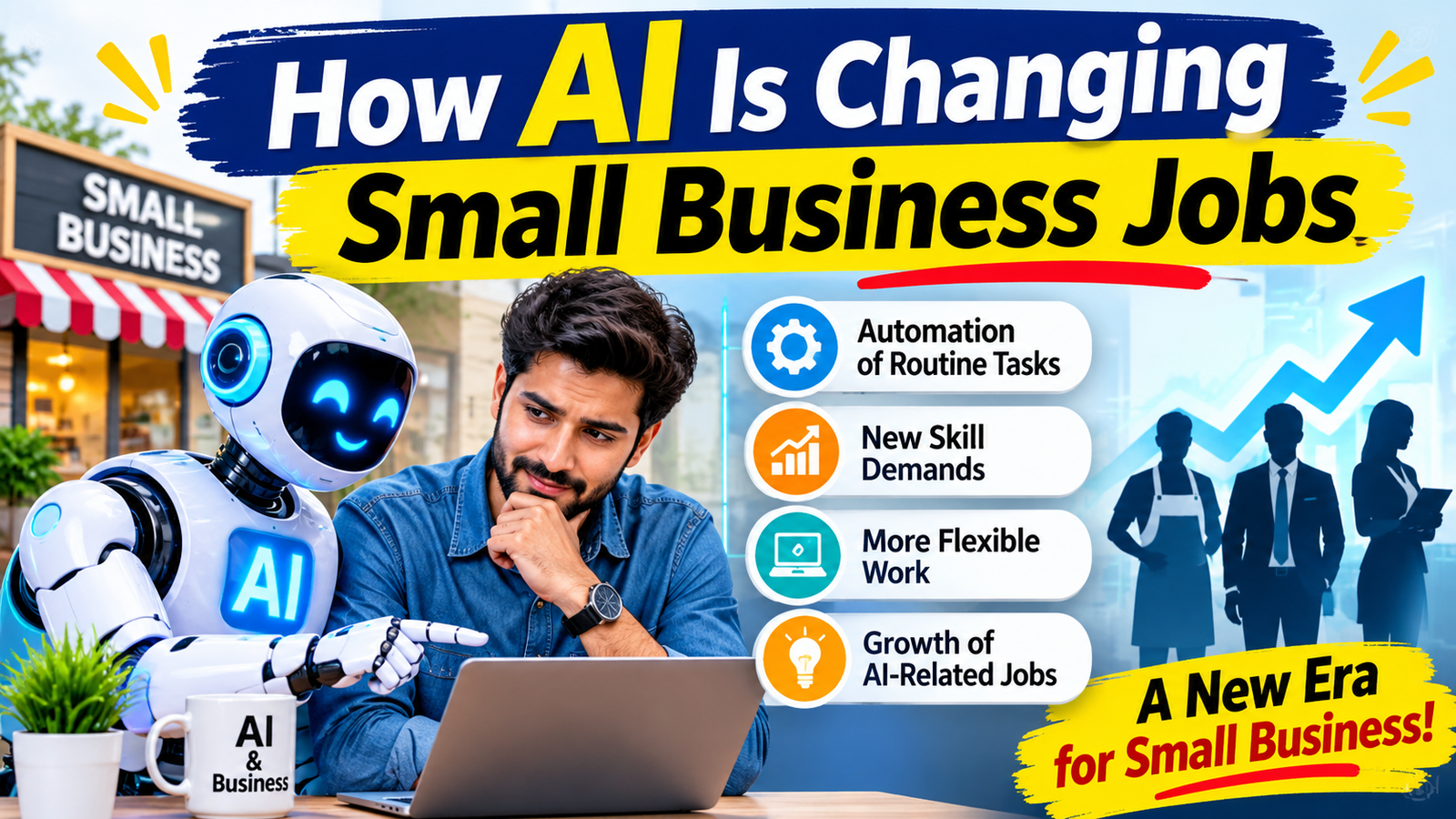
Learn how 31% of SMEs are already using AI to boost performance, and how the shift from ‘doing’ work to ‘supervising’ it is transforming roles.
Generative AI helps SMEs boost productivity by automating daily tasks and enhancing decision-making capabilities.
The demand for advanced AI skills is growing, causing traditional job roles to evolve into tech-enabled positions.
Small businesses that use AI tools achieve efficiency and competitiveness without resorting to large-scale staff cuts.
Artificial intelligence has now become a part of the day-to-day operations of small businesses. Over the past few years, accessible tools for handling language, images, and structured data have integrated AI into daily workflows. This shift is clearly reflected in adoption rates, the way work is organized, and how job titles and skills are valued. While this technology is not replacing job roles within small firms, it is reshaping the responsibilities and skills required for those roles.
The scope of adoption is extensive, but its impact varies depending on the scale.
A November 2025 OECD survey, covering 5,000 small and medium-sized enterprises (SMEs) across seven countries, indicates that 31% of SMEs now use generative AI. The adoption rate increases with the scale of the firm. Among those that have adopted it, 65% state that generative AI improves employee performance. Meanwhile, 83% report that it has not yet altered their overall staffing requirements. This suggests that, at this stage, augmentation is more common than replacement.
Other research points to a similar pattern. A 2025 global survey found that 88% of organizations use AI in at least one business function. Yet, only 39% report a clear impact on their earnings before interest and taxes (EBIT). This gap highlights that tools are often adopted much faster than the workflows they are intended to support are redesigned. Smaller firms—which frequently operate with limited capacity for change management—experience this gap more acutely, as achieving tangible results requires a fundamental rethinking of workflows, involving both people and systems.
Work has shifted from execution to orchestration.
AI shifts the center of gravity across many roles. In customer support, AI assistants now triage incoming inquiries, draft responses, summarize calls, and provide account context. Human agents, in turn, dedicate more time to handling exceptions, managing nuanced conversations, and coaching to improve system performance. In sales, tasks like drafting outreach, creating talk tracks, and logging notes are accelerated, allowing human focus to shift toward discovery, qualification, and negotiation.
Roles within the marketing function have also evolved. Content production has transformed from a one-off task into a continuous pipeline. Teams can instantly build content libraries, adapt material for different audiences, and ensure compliance with brand and legal guidelines. As output volume increases, resources are redirected toward maintaining consistent brand positioning, designing experiments, and analyzing performance data. Similar performance gains are evident within finance and operations teams.
Document intelligence streamlines bookkeeping, invoice capture, and reconciliation. Instead of manual data entry, staff can focus their energy on resolving exceptions, forecasting cash flow, and scenario planning. In human resources, AI handles resume screening, interview scheduling, and the drafting of job advertisements. This allows HR generalists to concentrate more on the quality of onboarding, capability building, and internal mobility.
Hybrid job titles are emerging in small teams.
Small businesses rarely create entirely new departments for AI. Instead, existing roles take on new responsibilities. For instance, an “AI Operations Lead” is often a “power user” who maps processes, selects co-pilots or agents, monitors quality, and maintains a backlog of automation ideas. Organizations that perform best with AI are more likely to redesign their workflows—which explains why this responsibility is significant even in firms with 10 to 50 employees.
“Prompt curation” is another responsibility, where a marketer or support lead might manage a small library of prompts and a set of approved knowledge sources, while also establishing guidelines to ensure that AI-generated outputs are accurate, brand-aligned, and compliant with relevant policies. Operations or finance teams may take on a “lightweight” data stewardship role—managing tags, taxonomies, and simple data contracts—to ensure that AI tools can retrieve the correct information.
Another example of how job titles have evolved due to AI is the role of a “part-time AI policy owner.” In this capacity, individuals are tasked with tracking model settings, consent, copyright issues, and regulatory updates—an area where many small and medium-sized enterprises (SMEs) report a need for training and guidance.