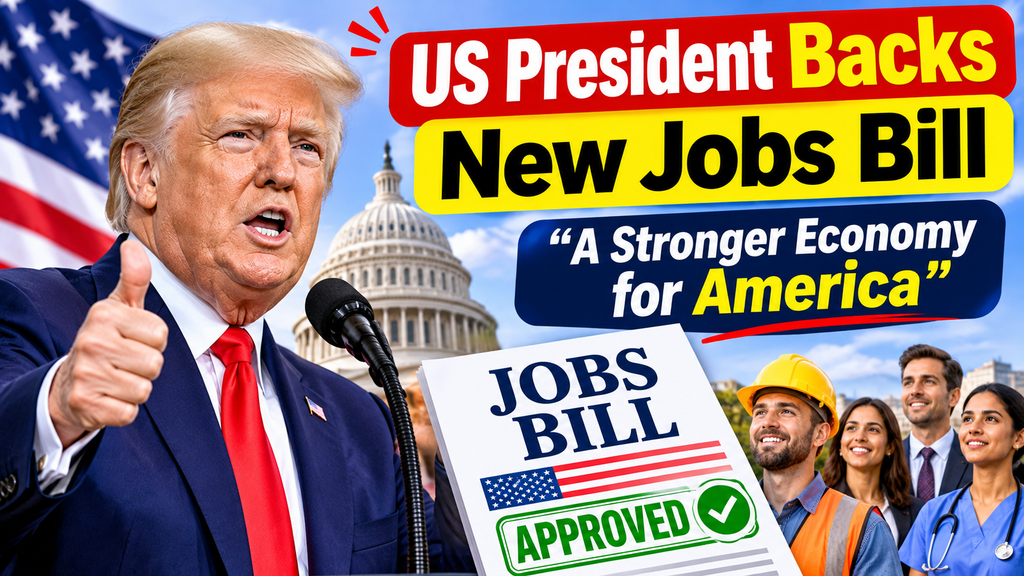
US President Donald Trump has urged senators and American citizens to support the “American Affordability and Jobs Act.” He states that this legislation will boost energy production, lower electricity costs, and ensure that data centers can cover the expenses for the power infrastructure they require. In a post on Truth Social on Sunday, Trump described the proposed legislation—designated as S. 5653—as a “major win” for US energy independence and energy dominance. He noted that the measure would accelerate the approval process for essential energy projects and codify what he terms his “Ratepayer Protection Pledge.” Trump wrote, “Call your senators and tell them to support the American Affordability and Jobs Act,” while calling on the public to back the bill.
Trump said the legislation includes allowing reforms that will speed up the construction of pipelines, mines, and power plants, helping to increase domestic energy production and infrastructure.
According to the president, this move is designed to reduce electricity costs for consumers and support economic growth and job creation by accelerating project development. The proposal aligns with Trump’s broader energy agenda since returning to the White House, which has focused on increasing fossil fuel production and reducing regulatory barriers.
Earlier this year, he declared a national energy emergency and relaunched his “Drill, Baby, Drill” campaign to increase domestic energy production.
What is the bill?
The bipartisan American Affordability and Jobs Act of 2026 was introduced on September 30 by a bipartisan group of senators, including Republicans Shelley Moore Capito and Mike Lee, and Democrats Sheldon Whitehouse and Martin Heinrich. The 417-page bill would overhaul the federal permitting process, including environmental reviews. According to a report by the trade outlet Contractor, the legislation would accelerate federal approvals for energy and infrastructure projects. It would also require large data centers—those with a power demand of 20 megawatts or more—to cover the full cost of the necessary grid infrastructure, ensuring that the financial burden does not fall on residential and commercial ratepayers. Supporters, including the National Association of Counties, argue that the bill would modernize an outdated permitting system.
Some environmental and public-interest groups are opposing the bill. Public Citizen and the Campaign for Public Lands argue that it weakens protections and promotes fast-track data centers. Critics have also objected to the fact that the bill is being largely negotiated behind closed doors and expressed concern that it could give the administration significant latitude over permits. Supporters say the bill contains safeguards. No Senate vote has yet been reported.
Data centers will pay for their own electricity costs.
A notable aspect of the bill concerns its approach to the rapidly growing electricity demand from artificial intelligence data centers. Trump stated that under this legislation, data centers would be required to pay for their own power infrastructure, rather than passing those costs on to households and other consumers. He further added that data center operators would be expected to invest in the surrounding communities. The President warned that imposing excessive restrictions on energy and data center development in the United States could benefit China, noting that projects rejected within the country might simply be relocated abroad.
Growing concerns about AI-driven power demand
How to manage the growing power demand from AI infrastructure has become a concern for both parties in Washington.
The Congressional Budget Office has stated that this legislation will apply to non-residential data centers that have a peak electricity demand of at least 100 megawatts at a single location, and that states will be permitted to decide whether or not to adopt the proposed federal standard.
Competition in China at the center of debate
Concerns regarding the maintenance of US leadership in artificial intelligence are increasingly becoming part of the discourse surrounding the expansion of data centers. Lloyd Blankfein, former CEO of Goldman Sachs, recently warned that opposition to data center projects could amount to “a gift to China.” Meanwhile, technology analyst Dan Ives has argued that the Democratic Party’s control over Congress could put certain planned US data center projects at risk, potentially slowing the development of AI infrastructure.
Trump expressed similar concerns in his appeal for support, describing the American Affordability and Jobs Act as a path to energy and economic competitiveness aimed at ensuring the United States stays ahead in the global AI race and protecting consumers from rising electricity prices.