
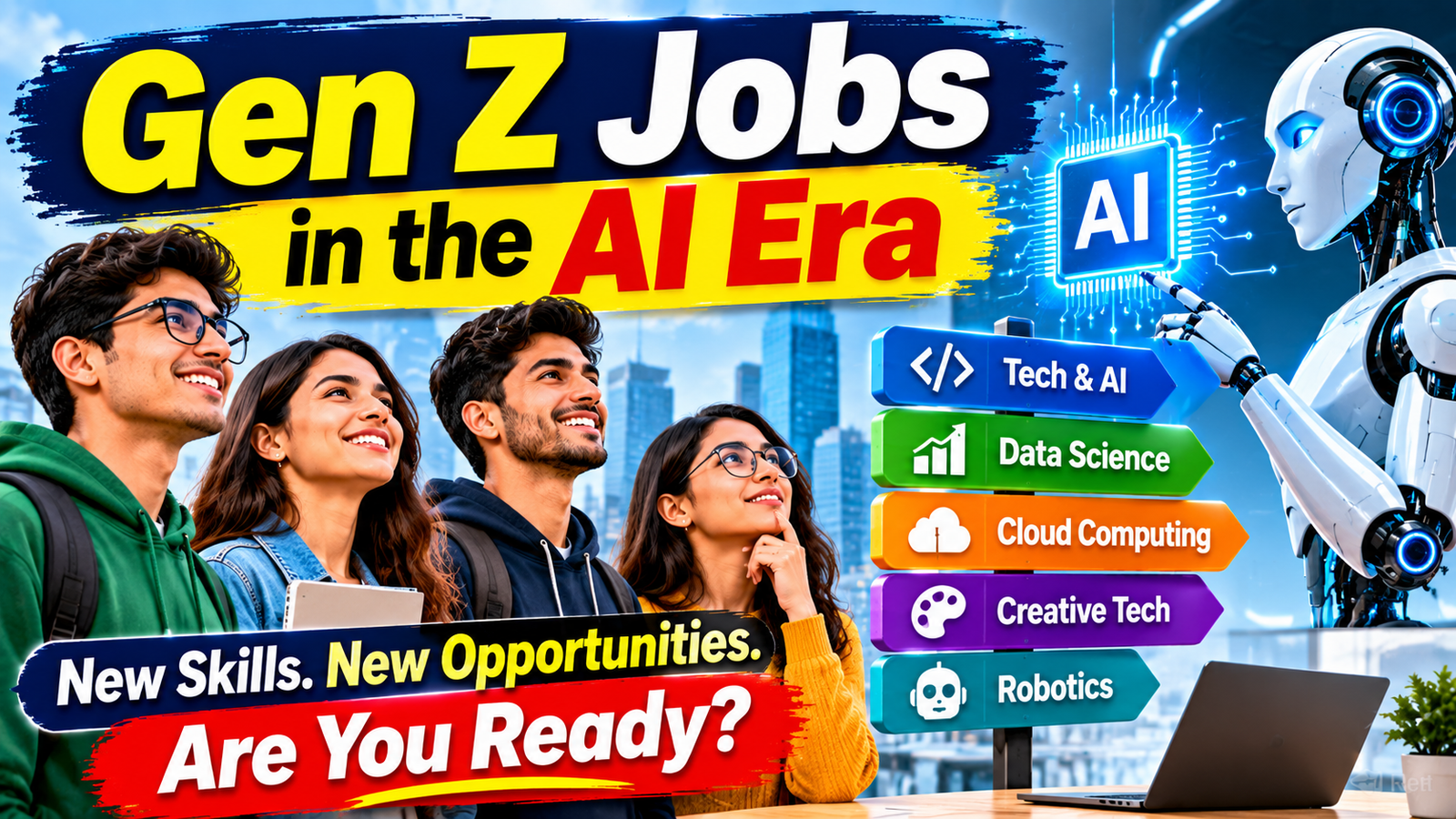
Every generation inherits a job market filled with new opportunities and challenges. For Generation Z, these opportunities and challenges are emerging faster than ever before. Technology is reshaping the nature of work at a pace that far outstrips the revision of traditional academic curricula; tasks that once served as the entry point for graduates—such as drafting, summarizing, formatting, and preliminary analysis—can now be performed by AI tools in a matter of seconds.

It is tempting to think that entry-level opportunities are dwindling; in reality, however, they are not disappearing—they are being completely reimagined. Graduates need to grasp this shift quickly, and Gen Z should prepare themselves in advance for this new era of work.
Some skills expire faster than others.
According to the World Economic Forum’s Future of Jobs Report 2025, 39% of core job skills are expected to change by 2030. The skills expected to be lost are routine drafting, manual data entry, standard reporting and rote methods.
Similarly, technical proficiency associated with a software interface may only provide short-term benefits because interfaces change frequently. What always remains the same is the importance of human judgment, carefully evaluating AI output, asking the right questions of AI tools, and taking full responsibility for the outcome.
In an economy where machines can provide responses on a massive scale, employers value candidates whose work can be trusted. While a well-crafted prompt is useful, a sound decision is truly invaluable.
Experience should be created, not merely assumed.
As AI automates routine tasks, young professionals can no longer afford to wait to gain experience. A joint study by Cognizant and Pearson found that 96% of HR leaders expect entry-level roles to evolve within the next five years, shifting the focus toward supervising and managing AI systems. The nature of work is transitioning from performing tasks directly to directing the technology that executes them.
In this landscape, internships, apprenticeships, applied industry projects, hackathons, and freelance engagements serve as new gateways into the workforce. Treat each of these as evidence of your capabilities. Document the scope of your projects, the specific AI tools employed, instances where the system faltered, and how human intervention corrected the output. Such a record demonstrates that decisions were made in real-world scenarios—a quality that employers value highly.
Learners should seek out programs where industry mentorship, real-world business challenges, and work-based assessments are central to the degree, rather than peripheral. Where institutions fall short, students can build their own portfolios through open-source contributions, business case competitions, and client projects. Ultimately, a portfolio that demonstrates sound judgment within a real workplace setting will carry more weight than a transcript of completed courses.
Employers want not just knowledge of tools, but also sound judgment.
Knowledge of basic AI tools is now merely a starting point. A report by Pearson and AWS, titled AI Readiness: Building the Bridge from Higher Education to Work, highlights a clear gap: 53% of employers struggle to find graduates with practical AI skills, and only 14% of graduates possess the proficiency required to effectively use AI tools within professional workflows.
Employers are looking for individuals who can clearly articulate problems, verify AI outputs, identify algorithmic bias, and keep confidential data secure. The ability to effectively communicate one’s reasoning is equally important—a skill that employers are now actively testing rather than simply taking for granted.
Can reskilling keep up the pace?
Reskilling can remain relevant, provided we change how it is delivered. Learning should be integrated into the flow of work—structured in short cycles tied to actual tasks, and focused on skills that can be verified rather than merely claimed. Investing just two to three hours a week in targeted capability building—and applying those skills to real-world challenges—will yield faster and more impactful results than occasional, intensive “crash courses.” Hiring practices are shifting in the same direction; instead of relying solely on academic credentials earned years ago, employers are prioritizing verified demonstrations of capability by asking: “What can you contribute today?”
However, the responsibility for workforce transformation cannot rest solely on young professionals. Microsoft’s 2026 Work Trend Index found that organizational factors—such as culture, managerial support, and modern talent practices—have more than twice the impact on how AI is adopted and utilized compared to the efforts of any single individual.
Employers need to rethink entry-level roles, focusing on human decision-making supported by mentorship and constructive feedback. Educators and policymakers should collaborate to identify essential skills and provide students with more opportunities to put those skills into practice.
Four Strategic Imperatives for Generation Z
- Build range: Combine your core technical strengths with the essential human “power skills” that set people apart—such as clear writing, effective communication, and thoughtful reasoning.
- Apply what you learn immediately: Use every new skill you acquire to address real-world challenges within a week of learning it.
- Exercise critical human judgment: Carefully examine the accuracy and potential bias of AI output, and clearly identify instances where human judgment should govern the final decision.
- Showcase your work: Maintain a dynamic portfolio that demonstrates the practical execution of your work, and earn credible, industry-relevant credentials that prove what you are capable of achieving in real-world workplace scenarios.
While no one can say for certain which specific technical skills will dominate the workforce in 2030, the principle holds that as AI becomes increasingly capable, uniquely human traits—such as human judgment, adaptability, and curiosity—will become ever more valuable.
Read More: EasyJet Plans Major Job Cuts


